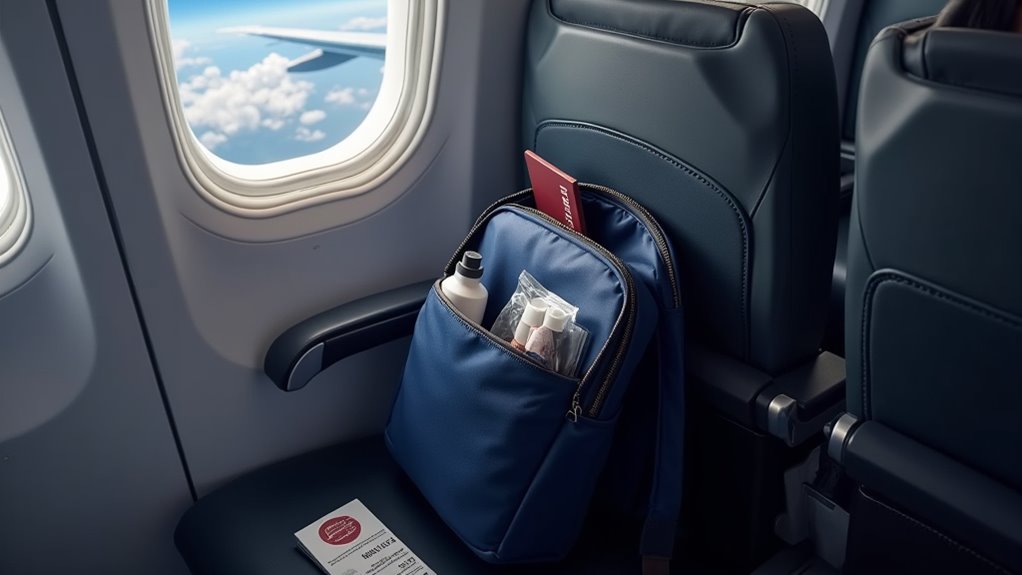

You can use a backpack as your personal item when flying, provided it meets your airline’s size requirements—typically around 18 x 14 x 8 inches for major U.S. carriers like American Airlines. Your backpack must fit entirely under the seat in front of you, so both its size and shape matter. Larger backpacks may have to go in the overhead bin as carry-ons, potentially incurring extra fees or hassles. Next, you’ll find out what features make backpacks ideal for travel.
When you’re preparing for air travel, understanding how a backpack qualifies as a personal item is crucial for a smooth experience at the airport. Airlines each have their own specifications, so you’ll need to check your carrier’s requirements before you pack.
Knowing whether your backpack counts as a personal item can make your airport experience much smoother—always check your airline’s specific rules.
For example, American Airlines specifies that a personal item, including a backpack, shouldn’t exceed 18 inches by 14 inches by 8 inches. Southwest Airlines is less strict with exact measurements but requires any personal item to fit entirely under the seat in front of you. If your backpack is too large to fit under the seat, airline staff may classify it as a carry-on, which could affect your boarding process and fees.
You’ll find that daypacks, which are designed for daily use and short excursions, are often the best choice to use as personal items. Their compact size usually fits within airline limits and under-seat storage requirements. Airlines distinguish between personal items and carry-ons, with personal items intended for under-seat storage and easy access to essentials. Medical or mobility devices do not count as personal items, so these do not impact your allowance for a backpack or other standard under-seat bag.
Travel backpacks, while offering more space, might exceed these size restrictions unless you carefully select a smaller model. When you choose a backpack, look for features like dedicated laptop sleeves, multiple organization pockets, and high-quality, durable material to guarantee it withstands the rigors of travel. Employing packing cubes can help maximize the limited space while keeping your belongings organized.
For security, you must follow TSA regulations, particularly regarding liquids. All liquids, gels, and aerosols in your backpack need to be in containers of 3.4 ounces (100 milliliters) or less, placed in a single, clear quart-sized bag. This bag must be accessible for inspection during security checks.
While most toiletries are permitted, medications and baby formula may be exempt from these limits, so you should carry any necessary documentation.
Using a backpack as your personal item offers several advantages, such as convenient access to your essentials, hands-free mobility, and the ability to distribute weight comfortably.
However, be aware of potential drawbacks. Large backpacks may fail to meet size restrictions, and security screening can take longer due to multiple compartments. On crowded flights, under-seat space can also be limited.