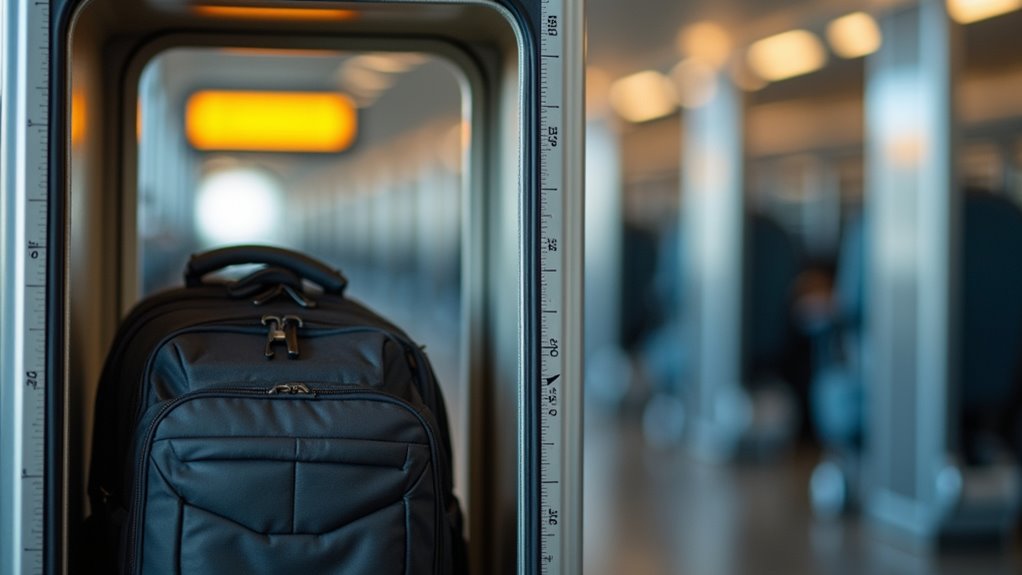
Airlines are usually strict about carry-on size limits, especially at boarding gates, on crowded flights, and during peak travel times. You’ll need to make sure your bag fits specific dimensions, which most U.S. carriers set at around 22″ x 14″ x 9″, though these numbers can vary between airlines and routes. Oversized bags often must be checked at the gate, sometimes for free. Being aware of each airline’s policy is essential if you want to avoid hassle—learn more about exact limits and enforcement next.
When preparing for a flight, understanding airlines’ carry-on size limits is essential to avoid unexpected delays or extra fees at the airport. Each airline sets its own policies regarding maximum carry-on dimensions, and these limits can vary even among U.S. domestic carriers.
Knowing your airline’s carry-on size limits is key to avoiding delays and surprise fees when you arrive at the airport.
For example, Avelo Airlines, Breeze Airways, American Airlines, and Alaska Airlines all restrict carry-on bags to 22 inches long, 14 inches wide, and 9 inches high, while Delta Air Lines uses a linear measurement system, allowing a combined total of 45 inches for length, width, and height. International airlines frequently have their own standards, sometimes permitting bags as small as 15.7 inches tall, with enforcement often stricter due to limited overhead space. [Most airlines do not have a carry-on weight restriction, but some do enforce weight limits, especially on international flights, so be sure to check if your carrier has a carry-on weight policy.]
You’ll also encounter rules for personal items, such as purses or laptops, which must fit under the seat in front of you. Dimensions for personal items differ by airline—Breeze Airways allows 17″ x 13″ x 8″, Avelo sets 17″ x 13″ x 9″, and American Airlines permits up to 18″ x 14″ x 8″. Alaska and Delta don’t specify exact measurements but require items to fit beneath the seat.
Airlines generally enforce these size limits closely, particularly during peak travel periods or on crowded flights. If your bag exceeds the stated limits, the gate agent may require you to check it at the gate. While this is often free of charge, you should expect that non-compliant baggage can lead to last-minute gate checks.
These standards are intended to maintain safety and efficiency, ensuring overhead bins can accommodate all passengers’ items. Linear measurement policies, like those used by Delta and Cape Air, provide flexibility in bag shape but maintain strict control over total size.
Aircraft size, passenger load, and route type (domestic or international) can influence how rigorously these rules are applied. The TSA doesn’t enforce carry-on size, so it’s your responsibility to verify and follow the airline’s guidelines before your trip. Always check your carrier’s specific policy for the most accurate and up-to-date information.