
To use hiking poles for safer, easier trekking, adjust them to suit your height and the terrain—shorten them for ascents, lengthen for descents—and hold the handles firmly while planting each pole opposite your leading foot. Maintain a steady, alternating rhythm to improve balance and reduce joint impact, especially on rocky or muddy trails. Choose poles with ergonomic grips and shock absorption for extra comfort, and always use appropriate tips to minimize trail damage. There are additional tips for maximizing safety and efficiency ahead.
Whether you’re traversing rugged mountain trails or tackling long-distance routes, using hiking poles can greatly enhance your trekking experience. Hiking poles are designed to reduce joint stress by distributing your weight more evenly, especially when you’re maneuvering steep descents or ascents. This helps minimize the impact on your knees, ankles, and hips, which is especially beneficial on rough or uneven terrain.
With two additional points of contact on the ground, you’ll also notice improved balance, reducing the risk of slips and falls on loose rocks, muddy paths, or narrow ridgelines. Proper length is crucial for maximizing benefits, so make sure your poles are adjusted to fit your height and the demands of the terrain. Studies show that using trekking poles can increase your caloric burn by about 20%, especially when you actively engage your upper body with each step.]
Extra points of contact from hiking poles offer greater balance, helping prevent slips and falls on tricky or uneven terrain.
As you incorporate hiking poles into your routine, you’ll find your upper body assisting your legs, which can boost your endurance during prolonged climbs or multi-day treks. Poles naturally encourage an upright posture, keeping your spine aligned and allowing your lungs to expand fully, which improves breathing and energy efficiency over long distances.
Many hikers report maintaining a steadier pace and covering ground more quickly when using poles, due to the rhythm and momentum they provide.
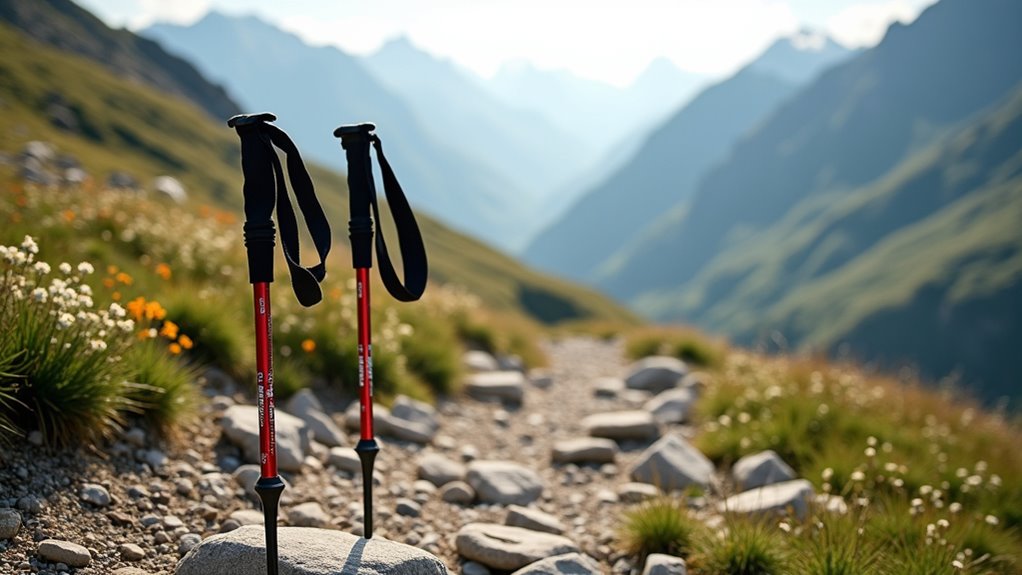
Choosing the right hiking poles is essential for comfort and effectiveness. Adjustable poles let you adapt their length for changing terrain and your height. Shock absorption features reduce strain on your joints, while lightweight materials like carbon fiber or aluminum make handling easier over extended periods.
Ergonomic handles minimize hand fatigue, and the right tips—rubber for trail protection, baskets for snow or mud—help preserve both your energy and the environment.
To use hiking poles effectively, practice a coordinated rhythm: alternate planting your poles with your steps for efficient movement. Hold the poles at a slight angle and adjust their length for ascents or descents—shorter for uphill, longer for downhill—to optimize support.
Always place poles on durable surfaces and use rubber tips to minimize trail damage. In challenging weather or during river crossings, poles can test stability and depth, and in emergencies, they serve as makeshift splints or signaling devices.