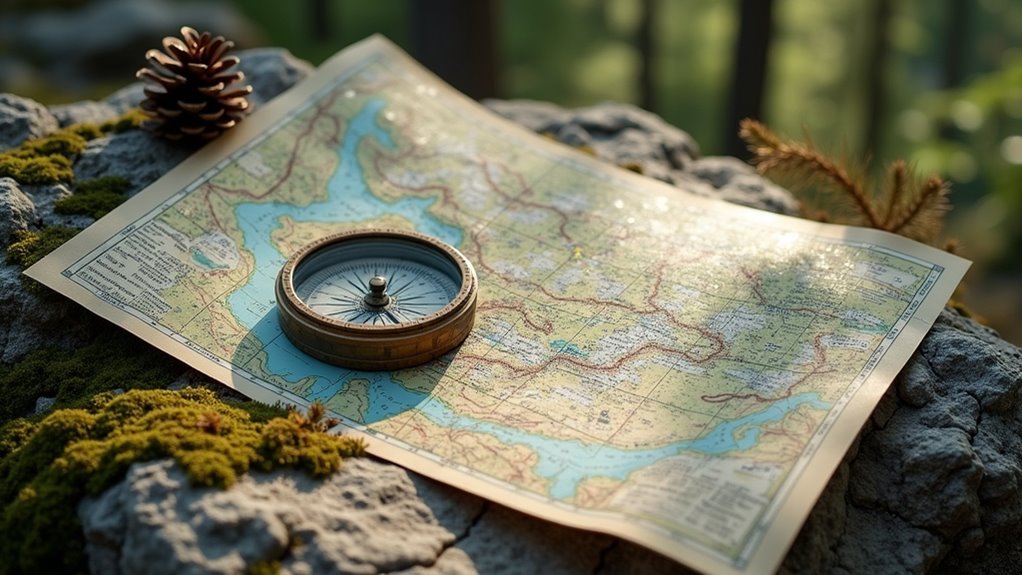

To navigate with a map and compass as a backpacker, start by studying the topographic map’s contour lines and symbols to understand the landscape and features. Familiarize yourself with the map’s legend and scale for accurate distance estimates. Adjust your compass for magnetic declination to find true north, then orient the map using the compass. Take bearings from your position to your destination and use visible landmarks for pinpointing your location. Next, you’ll discover how to apply these techniques in the field.
Whether you’re hiking in remote wilderness or preparing for outdoor emergencies, knowing how to navigate with a map and compass is a fundamental skill that guarantees safety and accuracy when GPS devices fail or lose signal.
You start by understanding topographic maps, which display terrain features such as elevation, water bodies, trails, and vegetation. These details are essential for situational awareness, especially when you need to interpret your surroundings. Contour lines on the map indicate elevation changes, letting you identify hills, valleys, and slopes, which helps you plan your route and avoid unexpected obstacles. Understanding terrain represented by map contours is essential for effective navigation, as it allows you to match what you see on the map with the real-world landscape. Regularly checking time at notable landmarks helps you track your progress and estimate your pace in different terrains, which is valuable for distance estimation and maintaining your planned route.
Familiarity with map symbols and the legend is critical, as these allow you to accurately interpret landmarks and other features. Knowing the map scale is also important, as it lets you estimate distances between points, ensuring you can plan travel times and water or shelter stops.
Understanding map symbols, the legend, and scale is essential for accurately interpreting landmarks and planning your route efficiently.
One detail often overlooked is magnetic declination, which indicates the difference between magnetic north and true north—critical for adjusting your compass so your navigation remains accurate.
A traditional compass consists of a baseplate with a direction of travel arrow, a rotating bezel with degree markings, a magnetic needle, and orienting lines. The magnetic needle always points to magnetic north, so you must adjust for declination to align compass readings with true north.
The direction of travel arrow is used to set and follow bearings, while orienting lines help you align the compass with the map’s north-south grid.
To orient your map, place the compass so the direction of travel arrow points north, align one edge of the baseplate with the map’s edge, rotate the bezel appropriately, then turn yourself and the map until the magnetic needle aligns within the orienting arrow. This aligns the map to magnetic north, matching map features to the terrain.
When taking a bearing, place the compass edge between your current location and destination, rotate the bezel to match the map’s grid, then follow the indicated direction.
For pinpointing your location, use visible landmarks, draw lines back from their mapped positions, and where lines intersect, that’s your position. Regularly check your location and adjust bearings as needed to remain on course.