
Hua Hin is often overlooked compared to other Thai beach destinations, yet it commands a pivotal role in Prachuap Khiri Khan Province’s economy and culture. Covering 86.36 square kilometers and evolving to township status in 2025, the city boasts a robust tourism sector—generating over 70% of provincial tourism revenue—diverse accommodations, and growing appeal among long-haul visitors. Its strategic focus on sustainable growth, infrastructure investments, and development of sectors such as medical tourism set it apart. Additional details illustrate its changing significance.
Although often overshadowed by Thailand’s more prominent beach destinations, Hua Hin has emerged as a significant coastal city in Prachuap Khiri Khan Province, covering an area of 86.36 square kilometers and incorporating both Hua Hin and Nong Kae sub-districts. This region has experienced rapid tourism-driven growth, leading to a surge in both registered and unregistered population numbers, which places considerable pressure on local infrastructure and services. In response, Hua Hin is evolving from a municipality to township status effective March 2025, a move that will grant local authorities enhanced control over resource allocation, urban planning, and development projects. Tourism and travel accounted for 8.9% of Thailand’s GDP, highlighting the importance of sustainable development in rapidly growing destinations like Hua Hin.
Hua Hin is rising as a major coastal city, experiencing booming tourism and growing pressures on its infrastructure and services.
Hua Hin plays a key role in Thailand’s tourism economy, with Prachuap Khiri Khan Province generating 44.24 billion baht in tourism revenue in 2023—over 70% of which originated from Hua Hin itself. This contribution is significant in the context of Thailand’s national target of 3.5 trillion baht in tourism revenue by 2024. With the city’s upcoming transition to special tourist city status, authorities anticipate even stronger economic performance and more streamlined management of tourism-related initiatives. Local authorities are investing in infrastructure upgrades to accommodate increased demand, positioning Hua Hin to further boost its economic output and manage the public service strain caused by the influx of visitors.
Visitor demographics reveal strong appeal to both domestic and international tourists, with notable growth from long-haul markets such as the UK, Germany, France, the US, and Australia. These segments are experiencing double-digit year-on-year growth, especially into 2025, and are a focus for high-value tourism strategies aimed at increasing per capita spending.
Enhanced transport connectivity with Bangkok and other cities supports this growth, while diverse accommodation options cater to a wide range of visitors.
Sustainable tourism is a guiding principle in Hua Hin’s ongoing development, with local authorities actively consulting business, civic, and environmental groups. Policy initiatives prioritize natural resource management and ecosystem protection to guarantee balanced growth and minimal negative impacts from rapid expansion.
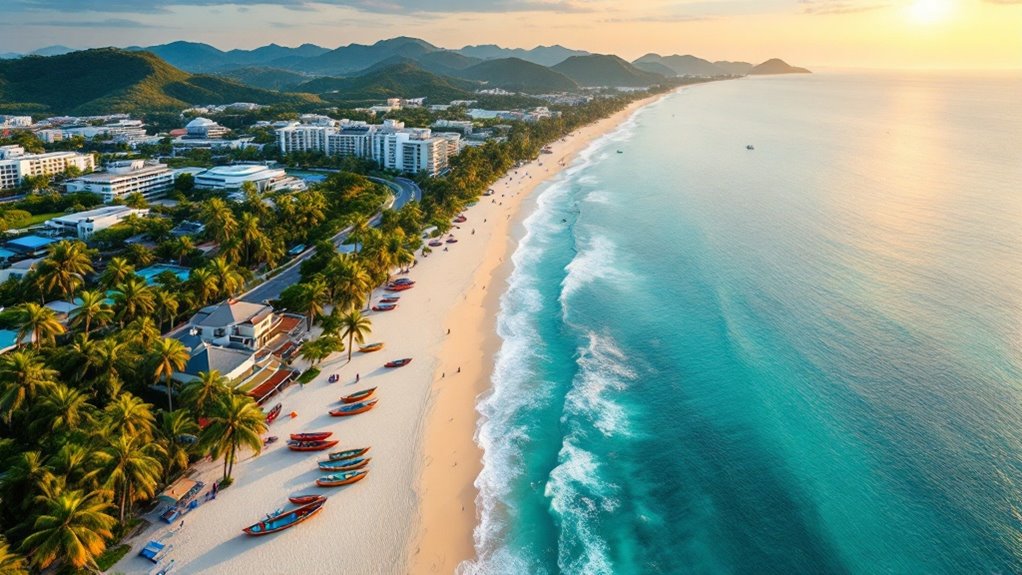
The city’s diverse offerings—from beaches and golf resorts to royal heritage sites and emerging medical tourism—underscore its strategic role as an increasingly important and sustainable coastal destination in Thailand.