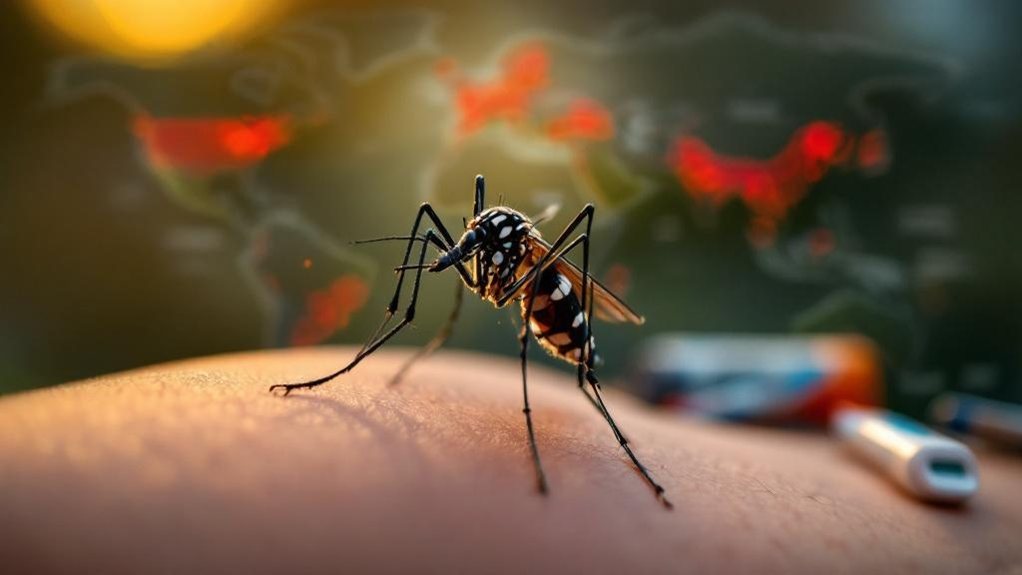

Chikungunya is rapidly spreading across Europe, Africa, and Asia, putting France under threat due to increasing *Aedes aegypti* mosquito populations. Severe outbreaks hit Africa with Mauritius, Réunion, and Somalia heavily affected. In Asia, Sri Lanka faces challenges due to immunologically naïve populations. France reported 38 locally acquired cases by July 2025, with concerns heightened by past clusters. Over 5.6 billion have been impacted worldwide recently, emphasizing urgent need for international health collaboration. Discover more by exploring the details.
As chikungunya resurges across multiple continents, the virus presents varying challenges and impacts in Europe, Africa, and Asia.
In Africa, the resurgence is particularly severe, with outbreaks in Somalia, Mauritius, and Réunion. Mauritius alone reported 1,395 locally acquired cases as of 2025, a significant number highlighting the virus’s rapid spread. Réunion, an overseas French territory, faced an even harsher reality with over 47,500 cases and 12 fatalities by May 2025. Mayotte, another French territory, experienced increased transmission, marking an end to nearly two decades of relative calm since the major outbreak between 2005 and 2006.
Mauritius faces a rapid chikungunya spread with 1,395 cases, while Réunion sees over 47,500 cases and 12 deaths.
In Asia, regions such as Sri Lanka and Indian Ocean islands report re-emergent outbreaks due to suitable *Aedes* mosquito vectors. The populations here are largely immunologically naïve, having not faced significant transmission for 20 years, thereby increasing their susceptibility. Vulnerable demographics include young children, the elderly, and those with pre-existing health conditions. Reflecting the global impact, approximately 5.6 billion people have been affected by chikungunya transmission across 119 countries over the past decade.
Asia faces challenges such as limited healthcare access and shortages of diagnostic reagents. There is a pressing need for retraining healthcare workers to manage these outbreaks effectively. Public health strategies emphasize vector control and vaccination, where available, alongside community education to mitigate transmission.
Europe, particularly France, is witnessing an uptick in locally acquired cases, with 38 reported by late July 2025. This marks a continuation of sporadic cases observed since 2010, with notable clusters in 2014 and 2017. The affected regions include Provence-Alpes-Côte d’Azur, Corsica, and others.
The expansion of *Aedes aegypti* mosquitoes into temperate climates exacerbates the outbreak risk, although the Europe CDC deems local transmission likelihood low, primarily linked to travelers introducing the virus into mosquito-populated areas. The ECDC Reports provide crucial monthly updates on the epidemiological situation, aiding international health efforts to curb the virus’s spread.
Globally, from June 2024 to June 2025, approximately 220,000 chikungunya cases and 80 deaths have been reported across 14 countries. While the Americas account for the highest case counts, Africa and Asia are experiencing significant outbreaks.
The geographic spread has intensified since March 2025, particularly in areas with naïve populations and established mosquito vectors, highlighting the ongoing challenge of managing this resurgent virus.