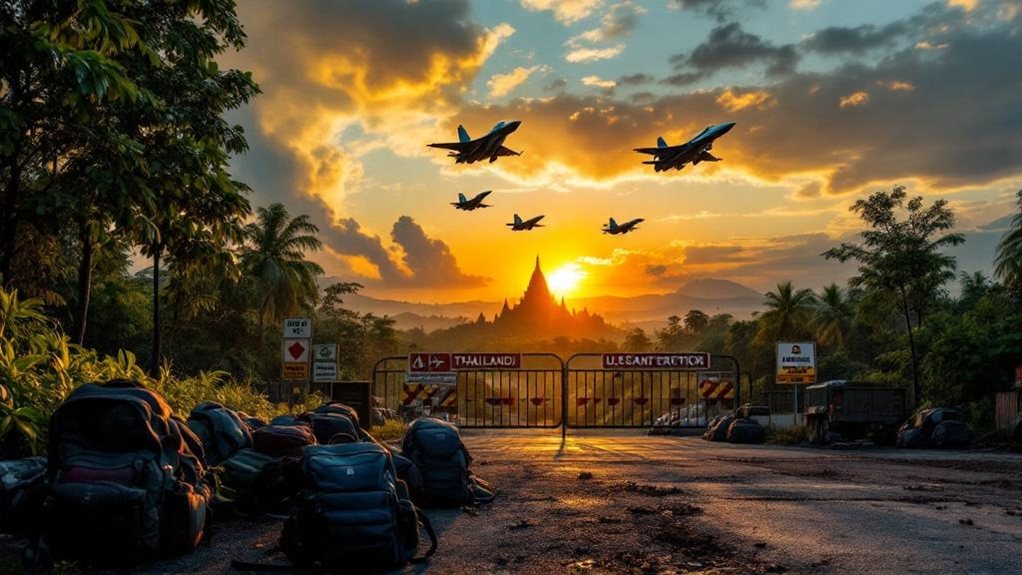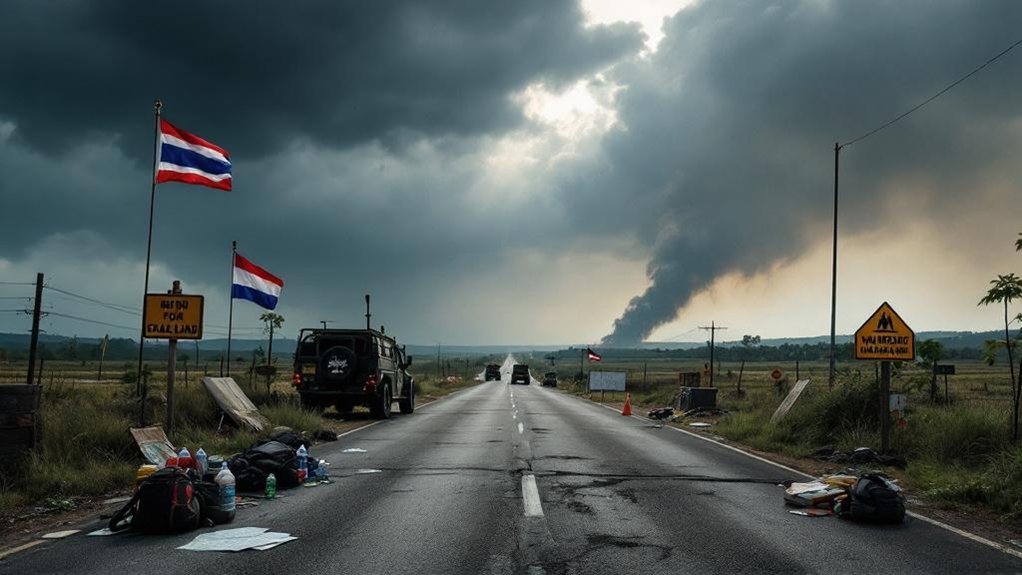

Escalating tensions between Cambodia and Thailand over the Prasat Ta Muen Thom temple have led to intensified military confrontations. Cambodia’s accusations against Thailand involve contentious F-16 airstrikes and halted gas imports, worsening economic struggles. The fighting has caused significant casualties, with at least 32 reported dead and caused civilian displacement in the border regions. ASEAN faces challenges in mediating the conflict as international bodies are drawn in. Unraveling the developments will shed light on geopolitical complexities.
Why has the border dispute between Cambodia and Thailand escalated into the deadliest conflict in over a decade? The renewed hostilities, which erupted on July 24, 2025, are rooted in a long-standing territorial disagreement surrounding the Prasat Ta Muen Thom temple. Initial exchanges of gunfire and artillery quickly intensified as Cambodia launched BM-21 multiple rocket attacks across the border.
Hostilities rooted in territorial disputes over Prasat Ta Muen Thom temple have escalated into deadly conflict.
In response, Thailand conducted F-16 airstrikes targeting Cambodian military installations, marking a sharp escalation in military engagement and heightening regional tensions.
Prior skirmishes on May 28, 2025, had already signaled brewing unrest, but the July conflict underscored the severity of the situation. On the day of the major confrontation, Cambodian UAVs and soldiers allegedly attempted incursions near the temple, prompting reciprocal accusations. Thailand claimed Cambodian forces fired within 200 meters of a Thai base, while Cambodia accused Thailand of unprovoked military aggression.
The artillery exchanges between the two nations resulted in significant civilian casualties and displacement, with Thai reports confirming 13 civilian deaths due to Cambodian attacks. As of 26 July 2025, at least 32 people have been reported killed, highlighting the tragic human toll of the conflict.
The conflict’s impact extends beyond military and human dimensions, affecting regional stability and economic activities. For instance, prior to the clashes, Cambodia’s decision to halt fuel and gas imports from Thailand underscored economic tensions intertwined with geopolitical disputes. This disruption severely impacted border regions reliant on cross-border trade and resources.
Diplomatically, the crisis presents a formidable test for ASEAN‘s conflict resolution capabilities. Cambodia’s appeal to the UN Security Council emphasizes the international dimension of the dispute, while Thailand’s accusations of Cambodia’s “inhumane” behavior illustrate deepening hostilities. The ASEAN Chair, Malaysia, has called for a cessation of hostilities and dialogue between the conflicting parties.
Despite the tension, Thailand has expressed openness to dialogue, although martial law in eight Thai border districts and evacuation advisories for Thai nationals in Cambodia highlight the precariousness of the situation.