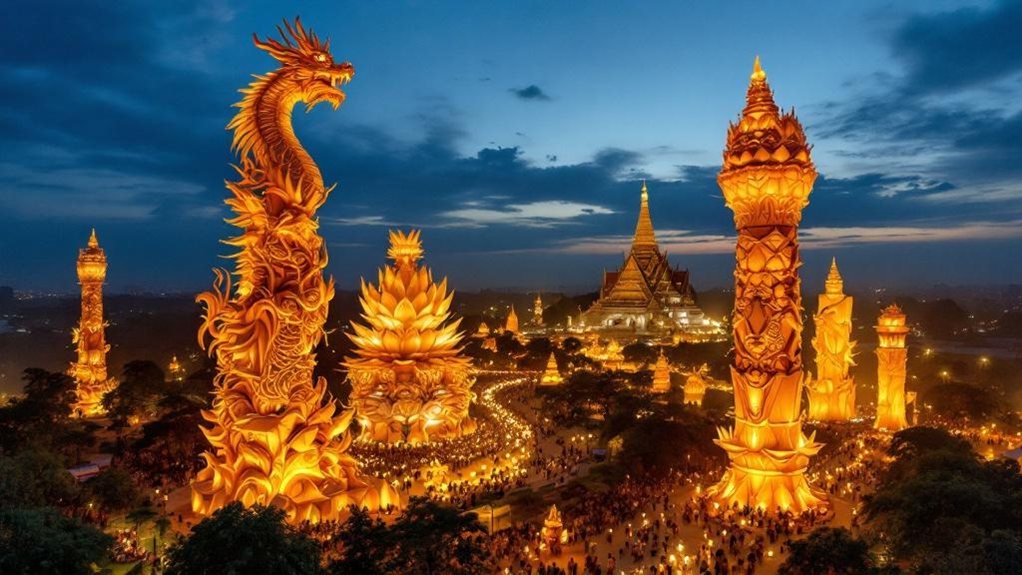
Prakhon Chai’s candle parade, celebrated during Buddhist Lent, is distinguished for its elaborate candle sculptures and vibrant festivities. The tradition, originating between 1901 and 1936, involves community collaboration to craft massive, intricately carved candles depicting lotus motifs and mythical characters. Supported by royal patronage, this event highlights the preservation of northeastern Thai culture. Visitors witness stunning artistry and community spirit in a grand parade commencing at Wat Si Ubon Rattanaram, promising more insights for those interested.
Although many regions in Thailand celebrate the Candle Festival with grandeur, Prakhon Chai’s Candle Parade stands out due to its deep cultural roots and unique artistic expressions. This event is part of a longstanding tradition tied to the Buddhist Lent, where offering candles to monks symbolizes illuminating their study and meditation during the three-month period. The tradition, dating back to between 1901 and 1936, was notably shaped by royal patronage, particularly under Prince Krom Luang Sanphasitprasong. His influence steered the focus towards a candle parade, emphasizing religious and cultural identity, and replacing other local festivals.
The cultural significance of the parade is profound, representing faith, devotion, and community spirit. It acts as a conduit for preserving northeastern Thai culture, particularly in Prakhon Chai. Over time, the event has shifted from a simple religious act to a major cultural festival, rich with artistic and communal elements. This evolution highlights the blending of ancient Buddhist customs with modern cultural expressions, creating a vibrant celebration of local heritage. Ubon Ratchathani, known as the birthplace of the Candle Festival, showcases stunning beauty in its candle carvings, drawing both Thai and international tourists. The festival includes a grand parade that begins at Wat Si Ubon Rattanaram in Thung Si Muang District, with grandstands lining the streets for spectators.
A vibrant celebration of faith and heritage, blending ancient customs with modern expressions in northeastern Thai culture.
Candle-making is a central feature of the festival, involving detailed community collaboration. Artisans work together to design elaborate candle sculptures that narrate local stories and folklore. These massive candles, often several meters long and high, feature intricate carvings and decorations such as lotus motifs and mythical characters. The community-driven design process fosters a strong sense of ownership and pride among locals, ensuring cultural heritage is well represented and passed on to future generations.
The Candle Festival aligns with the Buddhist holidays Asahna Bucha and Khao Pansa, usually falling in July according to the lunar calendar. In 2025, the parade is scheduled from July 11 to July 13, with main events commencing at 1 PM.
The festival encompasses a variety of activities, including candle-making demonstrations, parades, and religious ceremonies, spanning several days. These events draw considerable attention, placing Prakhon Chai on the cultural map alongside other notable candle festivals in regions like Ubon Ratchathani and Korat. Each year, the festival dates vary based on the lunar calendar, and visitors are encouraged to confirm details locally to experience the full breadth of this unique cultural celebration.